
The Science Behind Wet Basements in the GTA
The Science Behind Wet Basements in the GTA: Why Toronto Homes Are More Vulnerable Than You Think
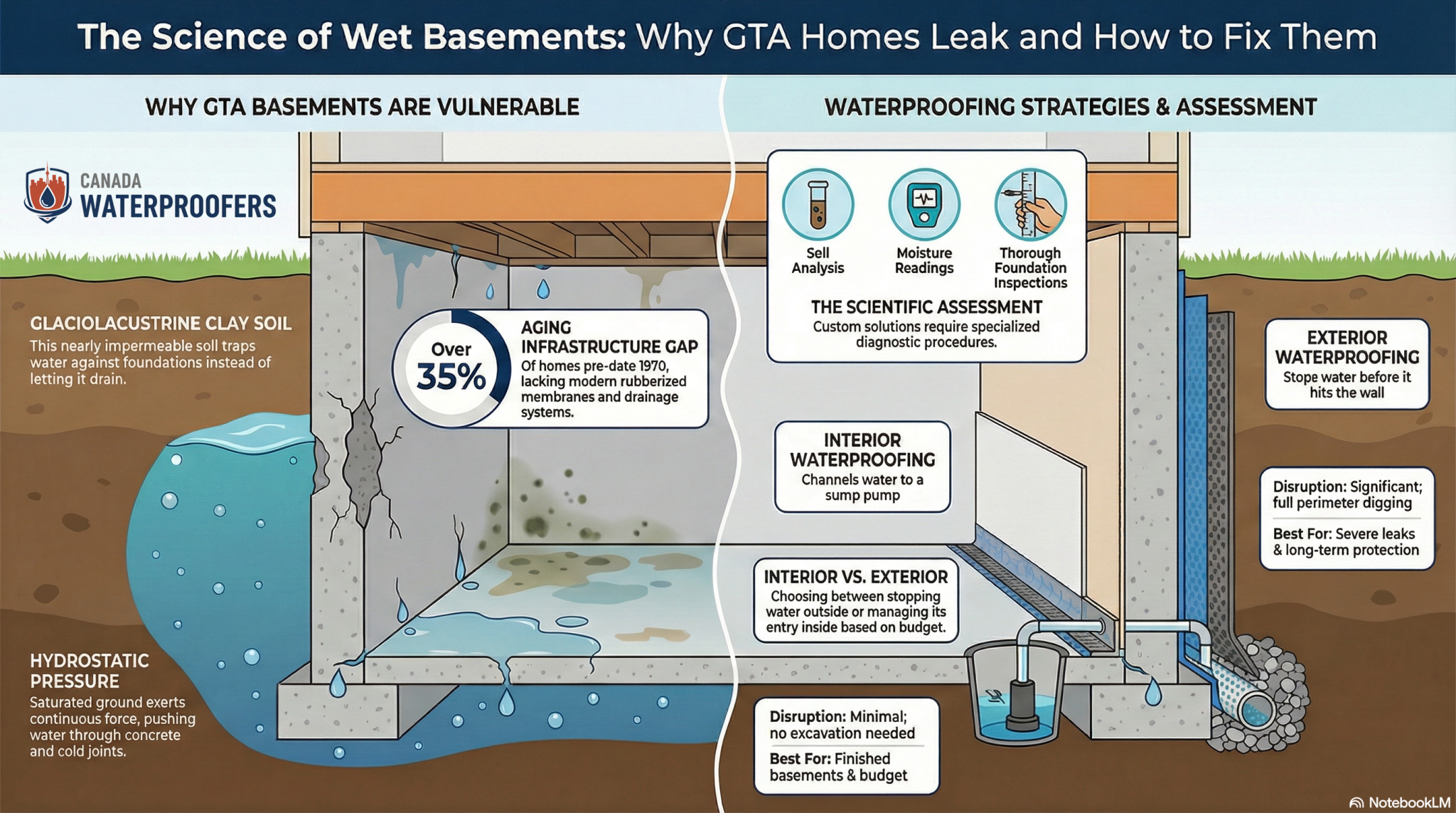
Every year, homeowners across Toronto and the GTA deal with the same frustrating discovery — a wet basement. Whether it's water seeping in after a heavy storm, seasonal dampness, or cracks forming in the foundation walls, the problem is rarely random. There's a scientific explanation for why GTA homes are disproportionately affected, and understanding it is the first step toward fixing it for good.
In this article, we'll break down the real causes behind wet basements in Toronto, Mississauga, Brampton, Vaughan, Scarborough, and surrounding communities — from soil composition and rainfall patterns to aging construction standards and hydrostatic pressure. We'll also explain how Canada Waterproofers designs custom, science-backed solutions that address the root cause, not just the symptoms.
The GTA's Geology: What's Under Your Home Matters
The single biggest reason so many GTA basements end up wet isn't poor construction — it's what's in the ground. The Greater Toronto Area sits on a dense layer of glaciolacustrine clay deposited over thousands of years by ancient lake systems. This clay-heavy soil is the defining factor in almost every wet basement case we encounter.
Clay Soil and High Water Tables
Unlike sandy or loamy soil that allows water to drain freely, clay is nearly impermeable. When rain falls or snow melts, water has nowhere to go — it accumulates around your foundation walls and floor. In many parts of the GTA, the water table sits relatively close to the surface, which compounds the problem significantly. The saturated ground exerts continuous outward and upward pressure on basement structures, a force known as hydrostatic pressure.
Aging Urban Drainage Infrastructure
Toronto's stormwater system was designed for the city's population and rainfall volumes of decades past. As urban development has expanded — more roads, driveways, and buildings mean less permeable ground — the existing infrastructure struggles to handle intense rainfall events. The City of Toronto has recorded a measurable increase in high-intensity storms over the past two decades, and aging combined sewer systems regularly back up, directing water toward the path of least resistance: your foundation.
Freeze-Thaw Cycles and Foundation Damage
Ontario winters create a damaging cycle that slowly compromises even well-built foundations. Water seeps into micro-cracks in concrete or mortar during warmer periods, then freezes and expands — widening those cracks incrementally with each cycle. Over 10, 20, or 30 years, what began as a hairline crack becomes a significant water entry point. This is why many Toronto homeowners notice their basement problems worsen each spring, even without a major flood event.
Why Older Toronto Homes Are at Greater Risk
Toronto's housing stock is among the oldest in Canada. According to Statistics Canada, approximately 35% of Canadian owner-occupied homes were built before 1970, and nearly half before 1980. In established Toronto neighbourhoods — from the Annex and East York to North York, Georgetown, and Scarborough — pre-1980 homes make up the majority of the housing stock. These homes were simply not built to withstand today's water pressure, storm intensity, or drainage demands.
Three construction-era vulnerabilities are most common:
-
No waterproofing membrane: Foundations built before the 1980s were typically sealed with tar or bitumen coatings that degrade over time. Modern rubberized membrane systems — now standard practice — did not exist. Without a functioning membrane, water passes directly through poured concrete or block foundation walls.
-
Failed weeping tiles: Older homes relied on clay weeping tile systems buried around the foundation perimeter to redirect groundwater. After 40–60 years, these tiles crack, collapse, or become blocked with roots and sediment. Once they fail, the drainage function they provided disappears entirely, and hydrostatic pressure builds against the foundation unimpeded.
-
Shallow foundations and thin walls: Pre-war and early post-war construction used thinner foundation walls and shallower footings than modern standards require. Without adequate depth or wall thickness, and with no vapour barrier or drainage layer, moisture migration through the foundation is almost inevitable.
"Every home is different. Soil conditions, foundation type, and basement depth all affect the right waterproofing approach. That's why we don't offer cookie-cutter solutions — we build a system that works for your home and your budget."
— Slava, Waterproofing Specialist, Canada Waterproofers
The Science of How Water Enters Your Basement
Understanding the mechanisms behind water intrusion helps you choose the right solution. There are four primary forces at work in most GTA basement water problems.
1. Hydrostatic Pressure
When soil surrounding your foundation becomes saturated, the weight and pressure of that water pushes forcefully against your walls and floor slab. This pressure — measured in kilopascals (kPa) — can force water through poured concrete, mortar joints, and even the cold joint where the wall meets the footing. French drains, sump pump systems, and interior drainage channels work by intercepting and relieving this pressure before it can cause damage.
2. Capillary Action
Concrete is a porous material. Even without visible cracks, water molecules are drawn upward and inward through microscopic pores in the concrete via capillary action — the same mechanism that pulls water up through a paper towel. This is why basements can feel perpetually damp even without an obvious leak source. Crystalline waterproofing compounds address this specifically: when applied to concrete, they react chemically with moisture to form insoluble crystals that permanently block the capillary pathways.
3. Lateral Water Movement and Poor Grading
Water follows gravity and pressure gradients. If the ground around your home slopes toward the foundation rather than away from it, or if window wells, downspout extensions, or patios direct water toward the house, you're essentially channelling water against your walls. Correcting the grade — ensuring a minimum 6-inch drop over the first 10 feet from the foundation — is one of the most cost-effective preventive measures available.
4. Condensation and Vapour Diffusion
Not all basement moisture originates from outside. Warm, humid air entering a cool basement condenses on cold concrete surfaces, contributing to dampness, mould growth, and the musty odour homeowners often associate with "an old basement." Vapour barriers and proper ventilation — including dehumidification — are essential components of a complete waterproofing system.
Interior vs. Exterior Waterproofing: What's the Difference?
The right approach depends on the source and severity of your water problem, your foundation type, and your budget. Here's how the two primary methods compare:
| Interior Waterproofing | Exterior Waterproofing | |
|---|---|---|
| How it works | Intercepts water after it enters the wall, channels it to a sump pump | Stops water before it reaches the foundation wall |
| Process | Interior drainage channel, sump pump installation, wall membrane | Full excavation, membrane application, new weeping tile |
| Disruption | Minimal — no excavation required | Significant — full perimeter dig required |
| Cost | Lower | Higher, but more comprehensive |
| Best for | Managing ongoing seepage, finished basements, budget-conscious repairs | New construction, severe water intrusion, complete long-term solution |
| Warranty | Lifetime (Canada Waterproofers) | Lifetime (Canada Waterproofers) |
Canada Waterproofers offers both systems and — importantly — recommends the right one based on soil testing, moisture readings, and a thorough inspection of your foundation. Many Toronto waterproofing companies default to one solution. We don't.
Our Assessment Process: Why Custom Solutions Produce Better Results
Before recommending any waterproofing system, our specialists conduct a structured on-site assessment that includes:
-
Soil analysis — Identifying clay concentration and drainage capacity around your specific foundation
-
Moisture readings — Interior and exterior measurements that guide membrane selection and system design
-
Foundation inspection — Assessing wall type (poured concrete, block, or stone), visible cracking, efflorescence, and cold joint condition
-
Drainage evaluation — Reviewing existing sump pump performance, weeping tile condition, and exterior grading
This process ensures that every recommendation is specific to your home — and that you're not paying for a solution designed for someone else's problem.
What GTA Homeowners Are Saying
"We thought it was just a small crack" — Sarah, North York
We noticed a damp spot in the corner of our basement but didn't think much of it. A few weeks later, the smell was unmistakable. Canada Waterproofers came in, found that our weeping tiles had completely collapsed, and explained exactly how hydrostatic pressure was driving water through the cold joint. They installed an interior drainage system and the problem has been completely resolved.
"I had no idea water could come up through the floor" — Mark, Scarborough
After a heavy summer storm, water was literally rising up through the basement floor — not the walls. Canada Waterproofers explained the capillary action and hydrostatic pressure behind it, installed a sump pump and weeping tile system, and we haven't had a drop since — even through last spring's storms.
Frequently Asked Questions
Can waterproofing increase my home's value?
Yes. A professionally waterproofed basement is a positive disclosure in any home sale and reduces the insurance risk profile of your property. In Toronto's competitive real estate market, a dry, usable basement directly impacts resale value and buyer confidence.
Are there eco-friendly waterproofing options?
Yes. Crystalline waterproofing compounds are a low-impact option that work internally within the concrete without surface coatings. Sodium bentonite clay — a naturally occurring mineral — is also used in some exterior applications as a non-toxic, highly effective moisture barrier.
How long does waterproofing take?
Most interior waterproofing systems are completed in one to three days. Full exterior excavation projects typically take three to seven days depending on the perimeter length, soil conditions, and site accessibility.
What should I do after my basement is waterproofed?
Keep gutters and downspouts clear, inspect the foundation annually for new cracks, and ensure your sump pump is tested before each spring season. Maintenance is minimal — but it matters.
What is the most effective waterproofing method?
Exterior waterproofing is the most comprehensive approach because it prevents water from ever reaching the foundation wall. However, a well-designed interior system with a properly sized sump pump is highly effective for most Toronto homes and far less disruptive.
How long does waterproofing last?
Canada Waterproofers backs all of our waterproofing systems with a lifetime transferable warranty. If you sell your home, the warranty transfers to the new owner — a genuine value-add at time of sale.
Is basement waterproofing expensive?
Cost varies based on method, basement size, and site conditions. Interior systems typically range from $3,500 to $15,000. Full exterior waterproofing ranges from $8,000 to $50,000+ depending on scope. We provide itemized, transparent quotes with no pressure — and honour a Price Match Guarantee for comparable licensed work.
What is the cheapest method?
Interior crack injection and sealant application are the lowest-cost options, typically starting around $500 per crack. They are appropriate for isolated, minor issues but are not a substitute for a full drainage system in homes with recurring or widespread water intrusion.
Ready to Protect Your Home?
A wet basement in Toronto isn't a cosmetic problem — it's a structural and health risk that worsens with every storm season. Mould, foundation deterioration, and compromised air quality are the real cost of waiting.
Canada Waterproofers has protected over 1,000 GTA homes since 1998. Our specialists provide free, no-obligation in-home assessments with honest recommendations — not sales pressure.
 Call: 416-333-LEAK (5325)
 Email: [email protected]
Or fill out the form on this page to schedule your free assessment today.
About the Author
Carl McDowell is a senior waterproofing consultant at Canada Waterproofers with over 15 years of hands-on experience protecting homes across the Greater Toronto Area. Carl has overseen hundreds of foundation assessments and waterproofing installations across Toronto, Mississauga, Brampton, Oakville, and Vaughan, and holds certification in below-grade waterproofing systems. He is committed to helping GTA homeowners understand the science behind water intrusion — and the solutions that actually last.