
White Powder on Basement Walls (Efflorescence): What It Means & How to Fix It
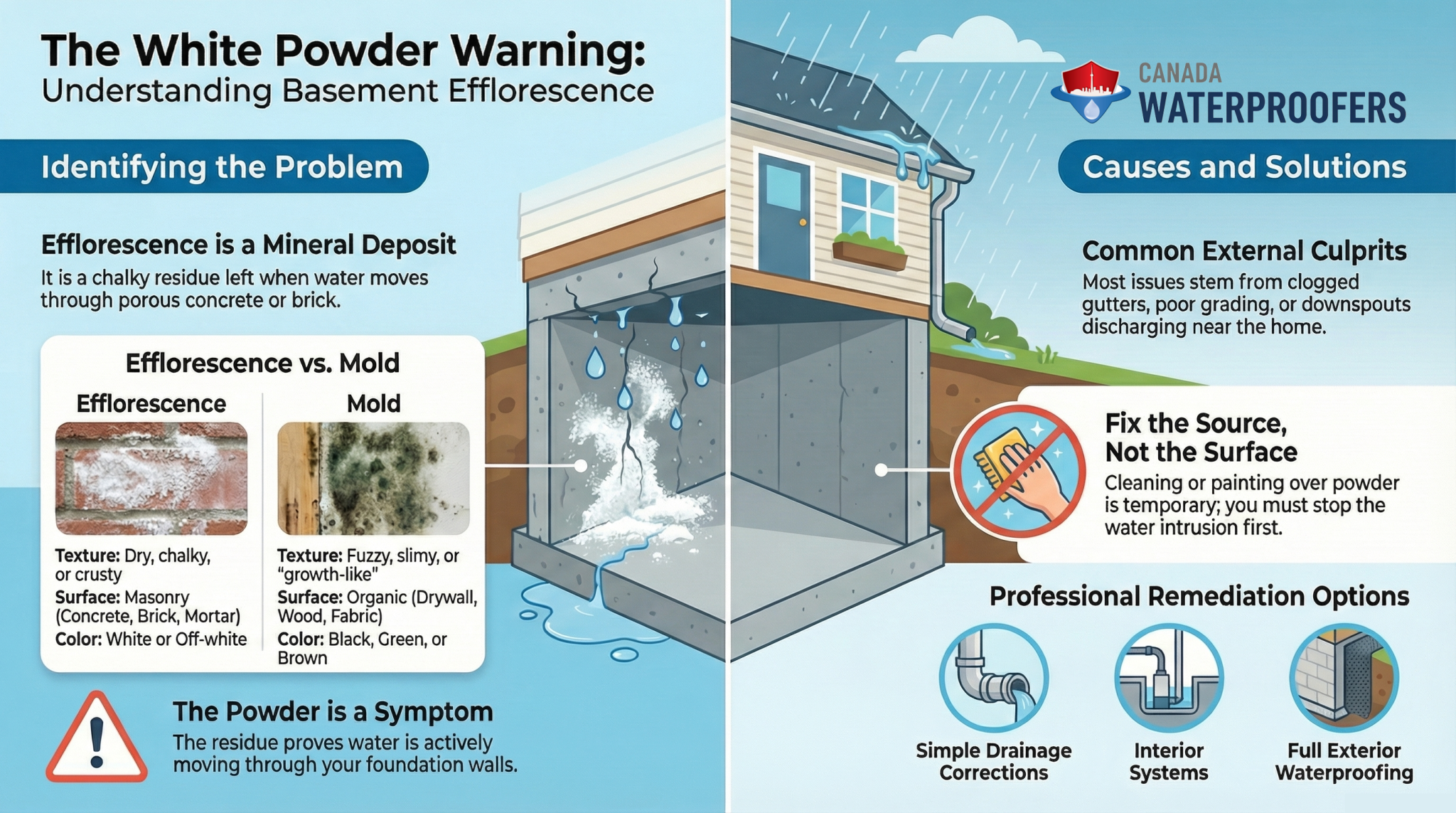
If you’ve noticed a white, chalky residue on a basement wall, you’re probably looking at efflorescence. It often gets mistaken for mould, but it’s usually a mineral deposit left behind when moisture moves through concrete, block, brick, or mortar and then dries at the surface.
It’s not the powder itself that matters most. It’s the fact that water has been there.
What Efflorescence Looks Like
Efflorescence usually shows up as a dry, white or off-white powder on masonry surfaces. In some cases, it wipes off easily. In others, it builds into a heavier crust that keeps coming back after cleaning.
You’ll usually see it:
- on poured concrete walls
- on concrete block walls
- along mortar joints
- near cracks
- at the joint where the wall meets the floor
Sometimes it appears as a light dusting. Other times it looks thicker and more stubborn, especially in areas where moisture has been moving through the wall for a while.
It can show up in one isolated area or across a larger section of the basement. Either way, it means moisture is passing through the foundation material and leaving mineral salts behind when it evaporates.
Why It Happens
Basement walls are below grade, which means they’re surrounded by soil. When that soil gets wet from rain, snow melt, poor grading, clogged gutters, or downspouts dumping water too close to the house, pressure builds around the foundation.
Water can move through small pores, weak joints, or cracks in the wall. As it reaches the inside surface and evaporates, it leaves salts behind. That’s the white powder you see.
Concrete and mortar may look solid, but they’re porous. They can absorb and transmit moisture, especially when water is sitting against the foundation for long periods. That is why efflorescence often shows up after heavy rain, during spring thaw, or in homes with ongoing drainage issues.
In many cases, the white residue is one of the first visible signs that the basement has a moisture problem.
Is It a Serious Problem?
Not always, but it should not be ignored. Efflorescence itself is not mould and is not usually harmful to touch, but it does point to a moisture issue that can lead to peeling paint, musty odours, damp insulation, mould on nearby materials, and damage to finished surfaces.
The residue is the symptom. The moisture is the problem.
A small patch on an unfinished basement wall may not mean you have a major waterproofing failure. But if it keeps coming back, spreads, or appears with other warning signs, there is a bigger issue behind it.
Over time, basement moisture can contribute to:
That is why efflorescence should be taken as a warning sign, not just a cosmetic annoyance.
Efflorescence or Mould?
They’re easy to confuse, but they’re not the same thing.
Efflorescence is usually white or off-white, dry, powdery, and found on concrete, brick, or mortar. Mould is more likely to be black, green, brown, or fuzzy, and it tends to grow on drywall, wood, fabric, and other organic materials.
A simple clue is texture. Efflorescence often feels dry and dusty. Mould tends to look more like growth. Efflorescence also appears directly on masonry surfaces, while mould is more common on finished materials or anything organic that has stayed damp.
Both can exist in the same basement if moisture has been there long enough.
That is part of the problem. Efflorescence itself may not be dangerous, but the same damp conditions that cause it can create a good environment for mould nearby.
What Usually Causes It
The most common causes are:
- poor grading around the home
- downspouts discharging too close to the foundation
- clogged or overflowing gutters
- hydrostatic pressure from saturated soil
- foundation cracks
- aging or failed exterior waterproofing
Sometimes the fix is simple drainage work. Sometimes it points to a larger foundation waterproofing issue.
Poor grading
If the ground around the home slopes toward the foundation instead of away from it, water collects where it should not. That increases the amount of moisture pressing against the basement wall.
Downspouts and gutters
When downspouts discharge too close to the house or gutters overflow, roof water ends up soaking the soil along the foundation. This is one of the most common and most fixable causes of basement moisture.
Hydrostatic pressure
When soil around the home becomes saturated, water pressure builds against the foundation wall. That pressure can force moisture through concrete, block, mortar joints, and cracks, even if you never see obvious water pouring in.
Foundation cracks
Cracks are direct entry points. Some lead to visible seepage. Others allow enough moisture movement to create staining and efflorescence over time.
Failed waterproofing
Older homes, or homes with aging foundation systems, may no longer have proper protection on the exterior side of the wall. Once that barrier fails, the wall becomes more vulnerable to ongoing moisture intrusion.
Can You Clean It Yourself?
Yes, if it’s light. A dry brush, vacuum, and basic cleanup will remove the residue from the surface, but that does not stop the moisture behind it.
If the white powder keeps returning, the wall is still taking on moisture. In that case, cleaning is only temporary.
For light buildup, homeowners can usually:
- brush the area with a dry, stiff brush
- vacuum the powder with a shop vacuum
- wipe the wall lightly if needed
- allow the wall to dry fully
That is fine for cleanup. It is not a real repair.
One mistake homeowners make is cleaning the wall and then painting over it too soon. If moisture is still moving through the foundation, the paint often starts peeling, bubbling, or staining again. Covering the wall does not solve the issue. It just hides it for a while.
What You Can Check Yourself First
Before calling a professional, there are a few basic things worth checking around the house.
Look at the grading around the foundation. Does the ground slope away from the home, or does it direct water back toward the wall?
Check where the downspouts discharge. If they dump water right beside the house, that needs to be corrected.
Take a look at the gutters. If they are clogged or overflowing, water may be spilling right along the foundation line.
After a heavy rainfall, go back into the basement and look at the same wall. Is the powder more noticeable? Does the wall feel damp? Are there darker patches or water stains?
These are useful observations. They can help identify whether the issue is connected to rainfall, drainage, or a specific area of the foundation.
When to Call a Professional
It’s worth getting an inspection if:
- the powder keeps coming back
- the wall feels damp
- you see water stains or seepage
- there are visible cracks
- paint is peeling or bubbling
- the basement smells musty
- the problem gets worse after rain or spring thaw
If you’re planning to finish the basement, it’s even more important to deal with the moisture first.
That last part matters. Many homeowners finish a basement before resolving the source of the water. Then the moisture ends up trapped behind drywall, under flooring, or inside insulation. At that point, the repair usually becomes more invasive and more expensive.
If the wall is showing efflorescence now, it makes sense to figure out why before putting finished materials in front of it.
How Canada Waterproofers Can Help
The right fix depends on where the water is coming from. In some homes, the answer is exterior waterproofing. In others, it’s an interior drainage system, crack repair, or a simple correction like improving grading and extending downspouts.
The goal is not to wipe the wall and move on. The goal is to stop the water from getting there in the first place.
At Canada Waterproofers, that starts with identifying the source of the moisture properly. Not every basement needs the same solution, and not every patch of efflorescence means the same thing.
Exterior waterproofing
When water is moving through the wall from the outside, exterior waterproofing is often the most direct long-term solution. This may involve excavating the affected foundation wall, repairing damaged areas, applying proper waterproofing protection, and improving drainage around the home.
Interior waterproofing
In some cases, an interior system makes more sense, especially when managing water at the base of the wall or when exterior access is limited. Interior waterproofing solutions can help control water and direct it away before it causes damage inside the basement.
Crack repair
If moisture is entering through visible cracks, a targeted crack repair may be the right answer. The important part is making sure the crack is assessed properly and not treated as an isolated cosmetic issue when it is part of a larger water problem.
Drainage corrections
Sometimes the biggest issue is not the wall itself. It is the amount of water being allowed to collect around the foundation. Fixing grading, extending downspouts, and correcting drainage outside the home can make a major difference.
Why It Shouldn’t Be Ignored
A lot of basement moisture problems start quietly.
At first it is just a little white powder in one corner. Then it starts coming back. Then the basement smells damp. Then paint starts peeling, or stored items start picking up moisture, or finished materials begin to show signs of damage.
Water problems rarely improve on their own.
The sooner the source is identified, the easier it usually is to prevent the problem from spreading. Waiting until the basement has visible seepage, hidden damage, or mould growth usually means a more expensive repair.